
We have run a gym on Mahakali Caves Road for eighteen years, which means we have eighteen years of attendance data shaped like a smile. High in January. Falling through the pre-monsoon heat. Bottoming out in July. Recovering in October, when everyone arrives having lost most of what they built.
The pattern is so reliable it stopped being interesting. What is interesting is the small group of members whose July looks like their January — and what they do differently.
What three months off actually costs
Less than people fear on strength, more than people expect on conditioning.
Maximal strength is stubborn. Trained lifters who stop entirely for eight to twelve weeks typically lose somewhere in the region of 10 per cent off their top lifts, and rebuild most of it within four to six weeks of returning. The neural component of strength is remarkably durable.
Cardiovascular fitness is not. Aerobic capacity declines noticeably within two to three weeks of inactivity and keeps sliding. That is why the October return feels catastrophic even when your numbers on the bar are close to where you left them — your lungs are the thing that quit, not your muscles.
Body composition is the quiet one. Three months of unchanged eating with no training does not produce dramatic weight gain, but it reliably shifts the ratio: slightly less muscle, slightly more fat, at the same number on the scale. This is why people return convinced the scale is broken.
Why July collapses
Almost never motivation. Almost always logistics.
The walk from the auto to the door soaks you. Traffic on Andheri Kurla Road turns a fifteen-minute trip into forty. Waterlogging makes an evening session a gamble. Add the darkness of an overcast 7 PM and the sofa wins on pure friction, not on willpower.
Which means the solutions are logistical too.
Six things that work
1. Move your session to the morning for the season. Rain in Mumbai is statistically heavier and more disruptive in the evening. A 6:30 AM slot in July is dramatically more reliable than a 7:30 PM one — and the roads are empty. Most of our members who hold consistency through monsoon made exactly this one change.
2. Keep a full second set of gear at the gym. Shoes, shorts, a towel, deodorant, a plastic bag for wet clothes. The reason people skip is often not the rain itself but the prospect of carrying a wet bag into an office afterwards. Locker facilities exist for exactly this.
3. Drop to a floor of two sessions, not zero. Set a monsoon minimum you would be embarrassed to miss: two full-body sessions a week. That is enough to maintain strength almost entirely. Three or four is better, but the point of a floor is that it survives a bad week. Zero is the only number that costs you the season.
4. Shorten the session rather than skipping it. Twenty-five minutes of the two main compound lifts, done properly, preserves the vast majority of the training effect. Turning up for a short session on a bad-weather day also keeps the habit intact, which is worth more than the session itself.
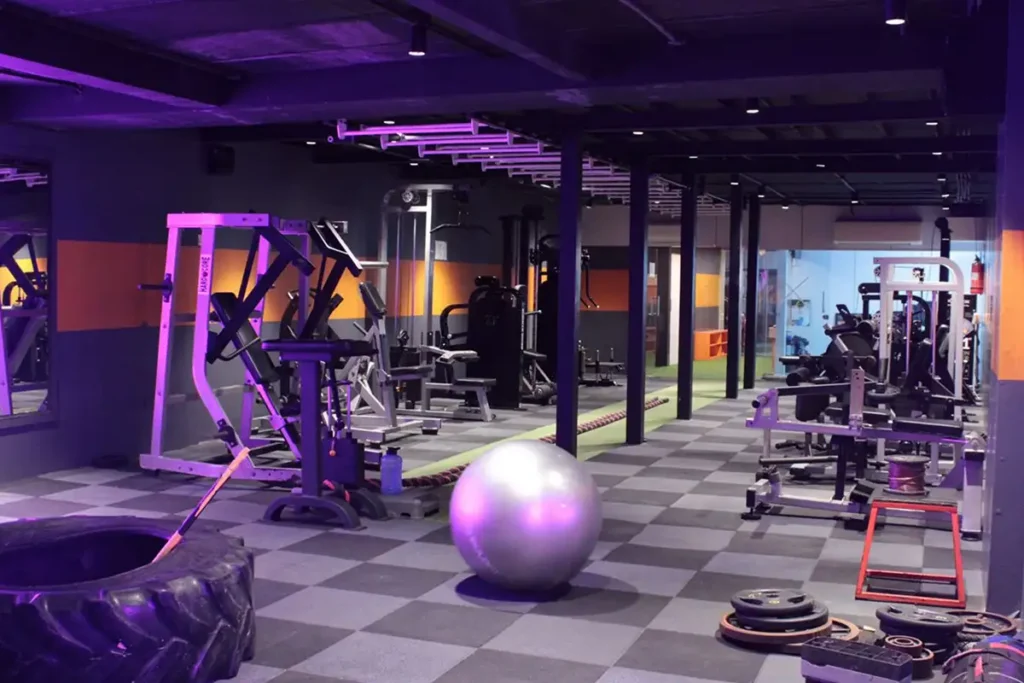
5. Train indoors, and pick a place where indoors means comfortable. Monsoon humidity indoors is its own deterrent — a gym that is warm and damp in July empties out regardless of the rain outside. This is a large part of why we air-condition the entire 6,000 sq. ft. floor rather than just the cardio corner.
6. Tell someone. Members with a trainer or a training partner hold attendance far better through monsoon than members training alone. Not because of the programme, but because somebody notices. If you train alone, tell a friend your two-session floor and report to them weekly. It sounds trivial. It is the most effective item on this list.
The mental reframe that helps
Stop thinking of monsoon training as maintaining progress and start thinking of it as protecting an asset. You spent January to May building something. Three months of nothing does not reset you to zero, but it does hand back a meaningful share of the work for no reason.
Two sessions a week between June and September is roughly twenty-six sessions. That is the entire cost of arriving in October where you left off in June, instead of spending until December catching up. Framed that way, it is one of the better trades available.
One practical note
If you are commuting to train, check the hours of wherever you go before the season starts. Gyms that close at 9 PM leave no margin for a delayed evening. We run 6 AM to midnight, Monday to Saturday, largely because Mumbai does not keep to schedule between June and September and neither can our members.
If you are somewhere near Sher-e-Punjab, Marol, MIDC or the Andheri Kurla Road stretch and want a floor that stays cool and open late through the season, here is how to find us. And if you want to know why we are still standing here after eighteen monsoons, that story is here.